InsightMath integrates the five essential components of equitable and engaging mathematics instruction outlined in the California Mathematics Framework. Through intentional design and implementation based on decades of neuroscience research into how the brain learns mathematics, particularly through the Perception-Action Cycle, our curriculum creates mathematics classrooms where students develop as confident, capable mathematicians.
Component One: Plan Teaching Around Big Ideas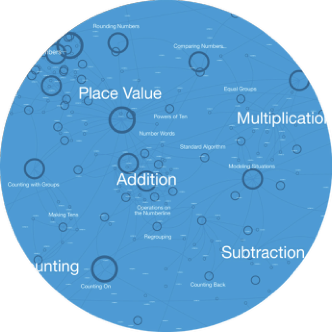
Each unit is structured around powerful mathematical Big Ideas that represent core mathematical understanding. These overarching concepts provide coherence across lessons, allowing students to see mathematics as an interconnected web rather than isolated skills. InsightMath's consistent unit structure supports this focus: beginning with a diagnostic assessment to identify prerequisite knowledge, followed by an Investigation lesson where students playfully explore the unit's big idea, then moving through clusters of related lessons sharing essential understandings, and culminating in a summative assessment. The thoughtful progression within units helps students build knowledge systematically, connecting current learning to previous experiences while establishing foundations for future concepts. This approach ensures students develop unified understanding rather than memorizing disconnected procedures.
Component Two: Use Open, Engaging Tasks
Our curriculum features rich, accessible tasks built on our spatial-temporal approach to mathematics, which provides multiple entry points and high ceilings throughout every grade level. Drawing from our decades of neuroscience research, InsightMath integrates visual-first problems that activate students' innate problem-solving abilities and natural learning mechanisms. Every lesson follows a consistent four-part structure that supports engagement: Launch (setting up mathematical context), Explore (investigating through hands-on activities), Reflect & Connect (discussing discoveries), and Workshop Time (personalized practice). These carefully designed activities allow all students to access mathematics through multiple modalities—visual, physical, and numerical—connecting to their strengths while providing appropriate challenge. The curriculum's puzzle-based learning includes ST Math-inspired activities that offer immediate, formative feedback, helping students revise their thinking in real time through the brain's natural Perception-Action Cycle. These open tasks enable teachers to assess student thinking formatively through the embedded "Look Fors" in lesson notes and respond to the diverse needs of learners.
Component Three: Teach Toward Social Justice
Cultural relevance is woven throughout the curriculum, helping students see themselves as capable mathematicians. Our Access and Opportunity framework specifically addresses four key domains: Agency (through personalized pathways and student-centered approaches), Asset-Based Approach (acknowledging and building on student knowledge), High Expectations (opportunities for all students to demonstrate brilliance), and Community and Family Connection (connecting mathematics to students' lives). The curriculum features a diverse cast of student characters with rich backstories, personalities, and interests that reflect the experiences of learners across the country. Students regularly engage with contexts that connect mathematical thinking to authentic situations through carefully structured word problems that build from concrete to abstract understanding, helping them recognize mathematics as a tool for understanding and impacting their world. The InsightMath approach positions all students as valuable contributors to the mathematical community by emphasizing that mathematics is "from everywhere, in everything, and for everyone."
Component Four: Invite Student Questions and Conjectures
Every lesson creates space for students to exercise mathematical curiosity through InsightMath's four-part lesson structure (Launch, Explore, Reflect & Connect, Workshop Time). Strategic activities like "disequilibrium moments" are intentionally built into the curriculum to encourage students to wonder about mathematical relationships and form their own ideas before formal instruction. These carefully designed moments of productive struggle push students to reconsider what they know in light of new ideas, activating the perception-action cycle that drives deep learning. The curriculum provides teachers with specific question prompts and discourse strategies that elicit student conjectures without reducing cognitive demand. Digital platform features like "Look Up" allow teachers to direct student attention at key moments during discussions. When students discover mathematical relationships through their own questioning and conjecturing, supported by InsightMath's visual models and manipulatives, learning becomes more meaningful and lasting.
Component Five: Prioritize Reasoning and Justification
Students regularly explain their thinking and justify their mathematical reasoning through carefully designed discourse opportunities facilitated by InsightMath's unique tools. Across grade levels, our three-part lesson structure (Launch, Explore, Reflect and Connect) ensures students have opportunities to make sense of problems, develop and compare strategies, and articulate their mathematical understanding. The curriculum utilizes specific discussion tools like Argumenteers (sample student work that displays various thinking strategies) and peer revoicing protocols to elevate student contributions. Every lesson includes formative assessment opportunities with specific guidance on what to look for in student reasoning and how to respond with appropriate support—not just checking for correct answers but understanding the mathematical thinking behind them. This intentional focus on student-centered mathematical discourse throughout the lesson helps students develop deeper conceptual understanding and stronger mathematical communication skills.
Through these five components, InsightMath creates mathematics classrooms where all students are engaged, supported, and challenged. Teaching for equity and engagement isn't an add-on or separate initiative but is integrated throughout curriculum design, instructional approaches, and assessment practices.